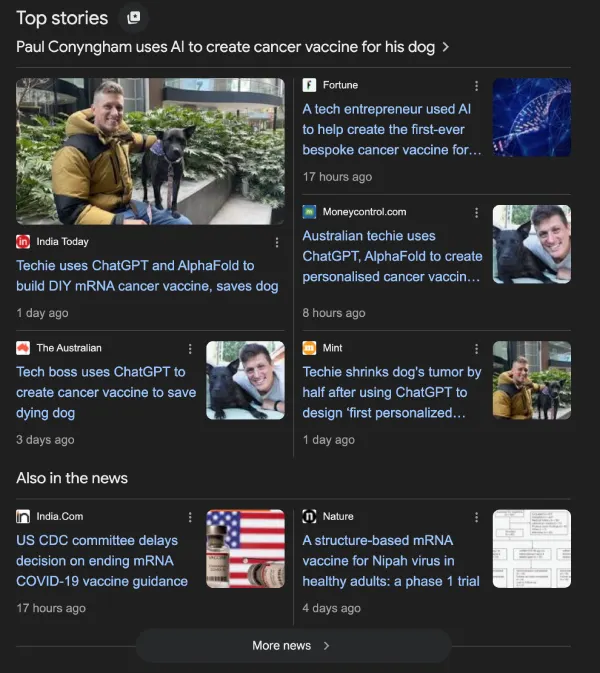
A viral story about a personalized cancer vaccine created for a dog using artificial intelligence has captured global attention, but new details reveal that the technology behind the breakthrough is more complex than many headlines initially suggested.
Australian tech consultant Paul Conyngham recently clarified that while ChatGPT played a role in the research and planning stages, the final molecular design of the experimental vaccine was generated by Grok, an AI model developed by xAI.
The story gained widespread attention after Conyngham shared how he attempted to create a personalized cancer treatment for his dog, Rose, after veterinarians reportedly gave her between one and six months to live.
Using AI to Design a Treatment
Conyngham, who has no formal background in biology, began by paying about $3,000 to sequence Rose’s tumor DNA. The genetic data was then analyzed with help from ChatGPT, which he used to research possible approaches and outline a strategy for building a targeted vaccine.
To better understand the mutations driving the cancer, he turned to AlphaFold, the protein-structure prediction system developed by Google DeepMind.
AlphaFold helped model the structure of the mutated proteins linked to Rose’s tumor, providing the biological blueprint needed to design a targeted treatment.
The final step involved Grok, which Conyngham says generated a codon-optimized mRNA sequence tailored to the specific mutations in the tumor.
Building the Personalized Vaccine
According to Conyngham, the AI-generated sequence included several important elements required for a functional mRNA vaccine:
- 5′ and 3′ untranslated regions (UTRs) to stabilize the RNA
- A 5′ cap to support translation
- A poly-A tail to increase RNA stability inside cells
The completed design was sent to researchers at the University of New South Wales (UNSW), where the vaccine was synthesized.
Rose reportedly began receiving the experimental treatment in December 2025.
Early Results Appear Promising
Within weeks of the treatment, Conyngham began documenting visible changes in Rose’s condition.
Photos shared online show that her ankle, which was previously severely swollen due to fluid retention and tumor growth, began to return closer to normal.
By late January, the Achilles tendon had become visible again, and the tumors appeared flatter and had turned gray in color.
Conyngham estimates that the tumor volume decreased by roughly 75% during the early phase of treatment.
A Viral Story Raising New Questions
The story quickly spread across social media and tech news sites, largely due to the unusual combination of AI tools, genetic sequencing, and personalized medicine being used outside a traditional research lab.
However, the case has also raised questions among scientists about safety, oversight, and the reliability of AI-generated biomedical designs without controlled clinical trials.
While the early results for Rose appear encouraging, experts say much more research would be needed to determine whether similar approaches could be safely applied to other animals — or eventually to human treatments.
Why This Matters
The case highlights how artificial intelligence is increasingly being used in biomedical research and personalized medicine. Tools like ChatGPT, Grok, and AlphaFold are giving individuals unprecedented access to scientific capabilities that were once limited to major research institutions.
However, the story also raises important questions about regulation, safety, and the role of AI in designing medical treatments outside traditional clinical environments.